The 1918 D.C.M. awarded to Battery Sergeant Major A. J. Cobden, Royal Field Artillery, late Royal Horse Artillery
Distinguished Conduct Medal, G.V.R. (47565 B.S.Mjr: A. J. Cobden. B.110/Bde: R.F.A.), good very fine.
D.C.M. London Gazette 8 September 1918, the original citation states:
'For conspicuous gallantry and devotion to duty when he showed much initiative in moving teams from a position where they were under heavy fire. When the captain was wounded he took his place, and with much skill and courage maintained the supply of ammunition to the battery.'
Arthur James Cobden was born in Southwark, Surrey around 1889 and first attested into the Army on 26 August 1907 at the age of nineteen at Stratford, after having made his living as a card cutter. The 1911 census shows him at age 22 as a Bombardier at the Royal Artillery Barracks in St. Matthew, Ipswich, Suffolk. He entered the Great War with the 7th Brigade, Royal Horse Artillery, disembarking with them at the Western Front on 15 August 1914 as a Corporal. At an unknown point, Cobden was transferred to the Royal Field Artillery with whom he served as a Warrant Officer Second Class, Battery Sergeant Major in the 110th Brigade.
Before the end of the War Cobden was married to an Agnes Margaret Burgess at Winchester in January 1918. Later they had issue of one son, Harold Arthur Cobden, born 27 March 1920 at Woolwich.
After the War, Cobden remained in the Royal Artillery under number 1018977. On 23 February 1919 he extended his service to complete 21 years and was permitted to continue until 25 August 1929. Cobden was later discharged on this date and had received his L.S. & G.C. medal a few years earlier in April 1926.
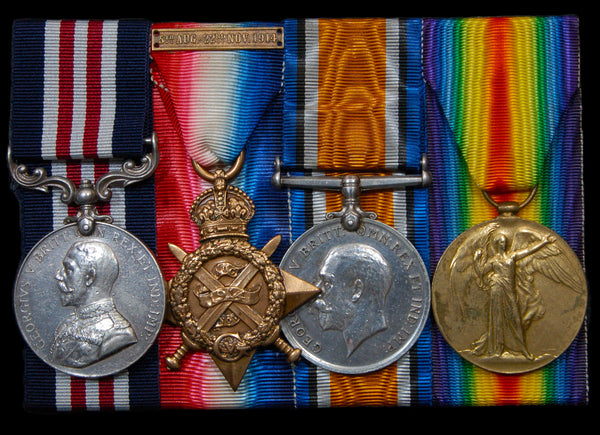
Cobden is further entitled to a 1914 Star, with clasp and roses, as well as a British War and Victory Medal pair, and a L.S. & G.C. Medal; sold together with copied research.